Shop Login
 Contact Us
Top 5 global Robotics-Trends 2025: The future of automation
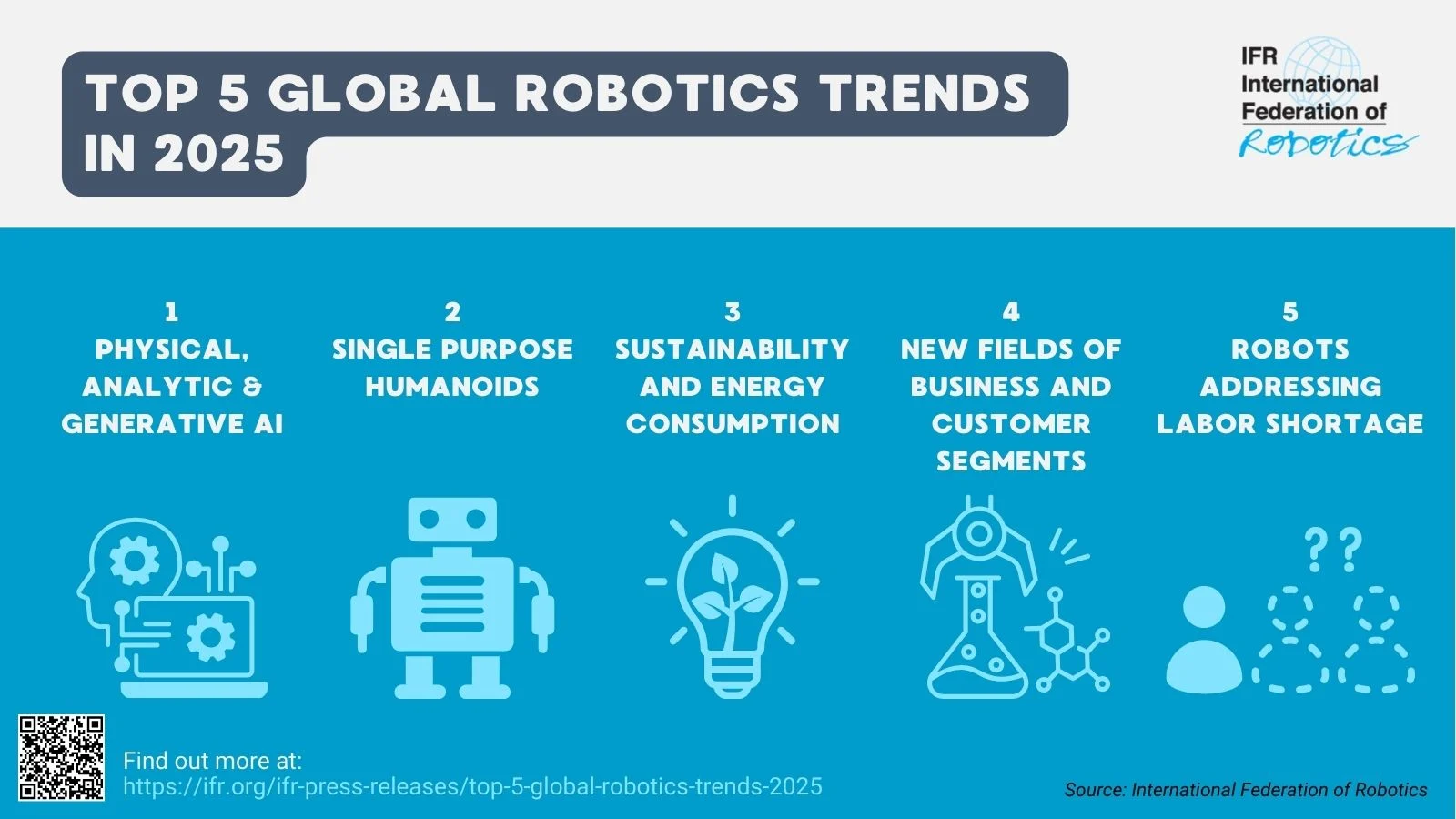
The robotics industry is dynamic and constantly evolving. The IFR (International Federation of Robotics) recently presented the top 5 robotics trends for 2025, which we would like to share with you. These trends will have a significant impact on the way we work and live in various industries.
1. Artificial intelligence (AI)
It is impossible to imagine modern robotics without AI. It is used in various forms:
- Analytical AI: robots analyze large amounts of data to react to unforeseen situations in real time.
■ Example: A robot in a warehouse dynamically optimizes its route to avoid obstacles and ensure the most efficient picking.
- Physical AI: Robots learn in virtual environments how to interact in the real world.
■ Example: A robot arm is trained in a simulation to perform complex assembly tasks before it is used in the production line.
- Generative AI: This technology has the potential to revolutionize robotics in a similar way to AI.
■ Example: A service robot capable of having human-like conversations and responding to requests in a natural way.
2. Humanoid robots
Humanoid robots that resemble humans are both fascinating and polarizing. While some think of them as general-purpose tools that will one day take care of the household, others focus on specialized humanoid robots.
- Example: A humanoid robot that performs complex assembly tasks in an automotive plant that are difficult for conventional robots to access.
3. Sustainability and energy efficiency
Sustainability is a key issue of our time. Robots can make an important contribution to achieving the UN sustainability goals.
- Example: robots in solar cell production, which enable precise and efficient production and thus reduce the costs of renewable energies.
- Example: robot arms with lightweight components that consume less energy and therefore reduce operating costs. Or robot controllers that feed electrical energy back into the power grid when braking.
4. New business areas and customer sectors
Robotics is conquering new sectors and customer groups.
- Example: low-cost robots for small and medium-sized enterprises (SMEs) that facilitate entry into automation.
- Example: robots in the construction industry that help with the construction of buildings and increase efficiency.
5. Robots against the labor shortage
The skills shortage is a global challenge. Robots can help to close this gap.
- Typical example: robots that take over repetitive and physically demanding tasks in production, so that human employees can concentrate on more challenging activities.
Conclusion
The robotics trends for 2025 promise an exciting future. AI, humanoid robots, sustainability, new business areas and combating the labor shortage are just some of the developments that will shape the industry in the coming years. It remains exciting to see how these trends will change our working world and our everyday lives.