

 Shop Login
 Contact Us
21.10.2024
Robotics and Automation: Preparing for the Future of Work
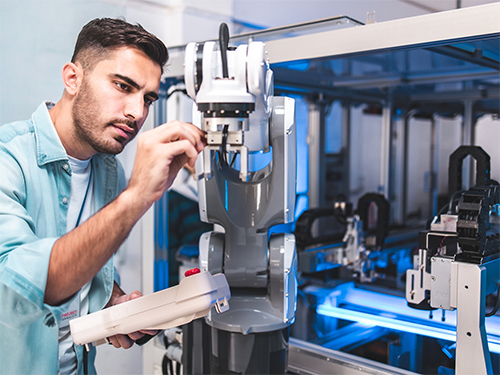
Robotics and automation technologies are advancing rapidly and are already transforming numerous industries today. To succeed in this dynamic environment, employees must possess the skills and knowledge necessary to work effectively with these new technologies. In this blog post, we will highlight the key aspects of employee training for working with robotics and automation systems.
Precondition:
The formal requirements for qualification in robotics and automation vary depending on the training program and the desired level of certification. Generally, though, basic technical knowledge, interest, and an understanding of mechanics, electronics, and programming are beneficial, whether they have been acquired through vocational training or proven otherwise. It is not uncommon for unskilled workers at our clients’ companies to seize the opportunity to qualify as vital contributors to production.
Motivation:
Motivation for qualification in this field is crucial for success. Employees who are passionate about technology and innovation, and who enjoy learning, are well-suited for this forward-thinking industry.
Precondition:
The formal requirements for qualification in robotics and automation vary depending on the training program and the desired level of certification. Generally, though, basic technical knowledge, interest, and an understanding of mechanics, electronics, and programming are beneficial, whether they have been acquired through vocational training or proven otherwise. It is not uncommon for unskilled workers at our clients’ companies to seize the opportunity to qualify as vital contributors to production.
Motivation:
Motivation for qualification in this field is crucial for success. Employees who are passionate about technology and innovation, and who enjoy learning, are well-suited for this forward-thinking industry.
Areas of Study:
The training encompasses a broad range of topics, including:
- Fundamentals of Robotics: Kinematics, dynamics, control systems
- Robot Programming: Various programming languages and environments, such as ROS, Python
- Sensing and Data Acquisition: Sensors, data acquisition systems, data processing
- Safety in Robotics: Risk assessment, protective measures, standards
- Automation Technology: Control systems, PLC, Industry 4.0
- Commissioning and Maintenance: Installation, configuration, troubleshooting
Yaskawa and Epson Training Courses
Independence vs. Expert Support:
While some basic tasks related to handling robots and automation systems can be learned independently, it is advisable to rely on the expertise of experienced professionals for more complex tasks. These experts can assist with programming, commissioning, and maintenance of robots, as well as troubleshooting and optimizing automation processes.
Ongoing Education:
Robotics and automation technology are constantly evolving. To stay up to date and meet industry demands, ongoing education is essential. Both companies and professionals should continuously invest in their development.
Funding Opportunities:
Numerous government and private funding programs support training in robotics and automation technology. These programs can reduce the costs of training and development, making access to these future-oriented qualifications easier.
External Specialists vs. Internal Training:
The decision to bring in external specialists or train employees internally depends on various factors. Internal training can enhance employee motivation, foster loyalty, and build in-house expertise. On the other hand, external specialists can provide specific knowledge quickly and efficiently when needed.
Conclusion:
Training employees to work with robotics and automation systems is a crucial factor in ensuring a company's competitiveness in today’s economy. By implementing targeted training programs, companies can prepare their workforce for the demands of the future, strengthening their position in a dynamic and innovative environment.